Afshan Carpet Design: An Exploration of Its History, Characteristics, Types, and Place in Interior Design
Introduction to Afshan Design
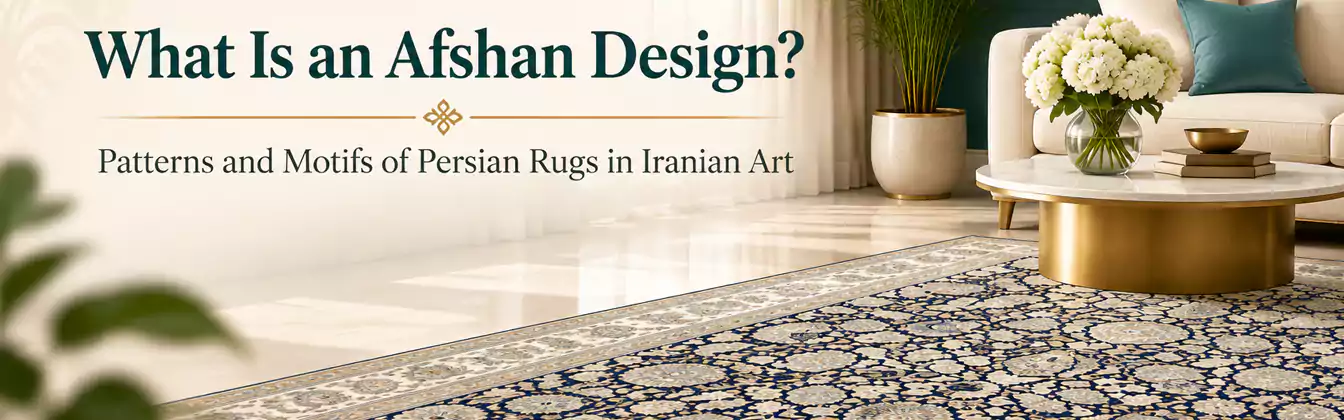
Among the distinguished patterns of Persian carpets, some are admired for their orderly compositions and captivating symmetry, while others express a different dimension of carpet artistry through the free-flowing arrangement of floral motifs, botanical elements, and winding branches. Afshan is one of the most distinctive expressions of this latter tradition in Persian carpet design, characterised by the harmonious distribution of flowers and ornamental elements across the entire carpet field, creating a composition that feels continuous, dynamic, and delicately intricate.
In many traditional carpet designs, the central medallion serves as the focal point, with surrounding motifs arranged symmetrically around it. Afshan, however, moves beyond this conventional structure. Rather than concentrating the ornamentation in a single area, its motifs extend across the entire field, coming together through an artistic interplay of forms to create a balanced and unified composition.
This distinctive quality allows Afshan carpets to retain the authenticity and artistic identity of Persian craftsmanship while appealing to a wide range of tastes and interior design styles. From formal, classically inspired spaces to contemporary homes with clean, minimalist arrangements, this design brings an elegant and captivating presence to any setting.
In this article, we explore the meaning and artistic origins of Afshan design, its defining characteristics, variations of its motifs, its differences from other traditional carpet patterns, and the essential considerations when selecting an Afshan carpet.
1. What Is Afshan Carpet Design?
Afshan is a recognised pattern in Persian carpet design, distinguished by the harmonious distribution of flowers, leaves, branches, and arabesque motifs throughout the carpet field.
The Persian word Afshan conveys the idea of scattering and spreading. In this design, ornamental elements are distributed across the carpet in such a way that no single area dominates the overall composition as its principal focal point.
An Afshan carpet typically does not feature a large, prominent central medallion. Instead, an interconnected arrangement of flowers and flowing branches extends across the entire surface. These motifs may incorporate intricate arabesque curves, delicate foliage, Shah Abbasi flowers, and Khatai elements, creating a composition rich in variety yet harmonious in appearance.
One of the defining characteristics of this design is the visual relationship between its individual elements. Flowers and branches are not placed independently or randomly across the field. Rather, they are connected through flowing curves and botanical forms, establishing a cohesive and carefully balanced structure.
For this reason, Afshan can be regarded as an example of continuous, non-centralised composition in Persian carpet art—a style whose beauty emerges not from a single dominant element, but from the harmonious relationship between its many motifs.
2. The History and Artistic Origins of Afshan Design in Persian Carpets
The art of Persian carpet weaving has long maintained a profound connection with nature, architecture, literature, and the artistic worldview of Iranian culture. Many traditional carpet motifs draw inspiration from flowers, plants, trees, climbing vines, and other natural elements, each expressing a different interpretation of nature’s beauty.
Afshan design belongs to this enduring artistic tradition. Rather than depicting a garden or landscape within a confined composition, this style allows botanical elements to extend across the entire carpet field, as though flowers and branches flow continuously without a clearly defined beginning or end.
The use of interconnected botanical motifs also has a long history in Persian decorative arts, including architecture, tilework, illumination, and miniature painting. Eslimi and Khatai motifs are among the most significant elements of this artistic heritage, recognised for their graceful curves, intricate flourishes, and elaborate floral compositions.
Over time, these elements found their way into various forms of carpet composition. Afshan is one of the design approaches that demonstrates the remarkable versatility of these motifs in creating a unified and visually balanced field.
However, Afshan should not be understood as a single, fixed pattern. Throughout its development, carpet designers have introduced numerous variations by modifying floral forms, branch structures, motif density, colour combinations, and the relationships between individual elements.
As a result, contemporary Afshan carpets range from richly detailed traditional compositions to more restrained designs with a distinctly modern character.
3. The Defining Characteristics of Afshan Carpet Design
What distinguishes Afshan from many other traditional carpet patterns is the way its decorative elements are organised across the carpet field. Several defining characteristics contribute to its distinctive appearance.
A. Harmonious Distribution of Motifs
The most recognisable feature of Afshan is the distribution of its motifs across the entire carpet surface. Flowers, leaves, and branches appear throughout the field, forming an expansive composition rather than concentrating around a central focal point.
This distribution does not imply randomness. Each element is carefully positioned according to its size, spacing, and relationship with the surrounding motifs.
B. The Absence of a Dominant Central Medallion
In many Afshan designs, there is no large or clearly defined central medallion. Consequently, the viewer’s attention is not confined to a single point, allowing the entire carpet surface to be appreciated as one continuous composition.
Some variations may incorporate a small medallion or a subtle central motif, but the overall structure remains centred on the distribution of decorative elements throughout the field.
C. A Rich Variety of Floral Motifs
Shah Abbasi flowers, Khatai blossoms, decorative leaves, winding branches, and Eslimi arabesques are among the recurring elements in Afshan design.
Their combination creates a visually rich composition while preserving the unity and balance of the overall pattern.
D. Flowing Lines and Interconnected Branches
In Afshan design, branches and flowing curves play an essential role in connecting individual motifs. These elements allow flowers and leaves to appear as part of a scattered yet interconnected arrangement.
E. Visual Balance Across the Entire Field
In this design, beauty is not confined to the centre or the borders. The thoughtful distribution of decorative elements ensures that different areas of the carpet remain visually connected and harmonious.
4. Different Types of Afshan Designs in Persian Carpets
Unlike patterns with a more rigid compositional structure, Afshan offers considerable flexibility in combining different decorative elements. This versatility has led to the development of several distinct variations within Persian carpet design.
4.1. Floral Afshan
In this variation, flowers serve as the principal elements of the composition, appearing in different sizes and forms throughout the carpet field.
Large and small blossoms are arranged alongside delicate leaves and branches, creating a lively and visually captivating pattern through variations in scale and spacing.
Floral Afshan is suitable for both classical and contemporary interiors. The density of the motifs, the size of the flowers, and the colour palette all play an important role in determining the carpet’s overall appearance.
4.2. Shah Abbasi Afshan
The Shah Abbasi flower is one of the most recognisable motifs in Persian decorative art, distinguished by its characteristic petal forms and intricate ornamental structure.
In Shah Abbasi Afshan, these flowers are distributed throughout the carpet field alongside foliage and Eslimi branches. Their combination with flowing lines and interconnected botanical elements lends the carpet an unmistakably traditional and classical character.
This variation is particularly appealing to those who appreciate traditional Persian motifs and intricate artistic details.
4.3. Eslimi Afshan
In this variation, Eslimi arabesques play a more prominent role. Their graceful curves, winding branches, and continuous flowing forms create a harmonious and fluid composition.
Eslimi motifs are generally combined with decorative flowers and leaves, adding depth and a sense of movement to the overall design.
Through its delicate lines and interconnected elements, Eslimi Afshan can bring an artistic and refined character to an interior.
4.4. Khatai Afshan
Khatai motifs are another important element of Persian carpet design. They typically consist of flowers, buds, leaves, and branches in a variety of decorative forms.
In Khatai Afshan, these elements are distributed throughout the carpet field while remaining visually interconnected. The diversity of floral forms and their relationship with the surrounding branches create a delicate and intricately detailed composition.
4.5. Medallion Afshan
Although one of the recognised characteristics of Afshan is the absence of a dominant central medallion, certain variations incorporate a small or subtly defined medallion within the centre of the carpet.
In this composition, the medallion functions as one element among many. Unlike conventional medallion-centred designs, it does not command the viewer’s entire attention.
4.6. Branch Afshan
In Branch Afshan, the extension of branches and the connections between botanical elements take precedence. Flowers and leaves are arranged along flowing, curved branches, creating a graceful and continuous composition across the carpet field.
Compared with some densely floral variations, this approach can offer a more restrained and orderly visual appearance.
5. The Difference Between Afshan and Lattice-and-Medallion Designs
Afshan and Lattice-and-Medallion are both recognised patterns in Persian carpet art. However, they differ considerably in their compositional structure and the way decorative elements are distributed across the carpet.
In a traditional Lattice-and-Medallion design, a central medallion occupies the middle of the carpet field, while four corner elements, known as Lachak, create a distinctive and symmetrical composition. The remaining motifs are arranged around the central medallion and throughout the surrounding field.
Afshan, by contrast, is defined by the distribution of motifs across the entire carpet surface. Botanical and ornamental elements extend throughout the field without relying on a single dominant centre.
| Feature | Afshan Design | Lattice-and-Medallion Design |
|---|---|---|
| Overall composition | Scattered and continuous | Centred and symmetrical |
| Central medallion | Usually absent or understated | Principal design element |
| Corner motifs (Lachak) | Generally absent | Essential design elements |
| Distribution of motifs | Throughout the carpet field | Arranged around the central medallion |
| Visual character | Fluid and unified | Classical and structured |
| Visual focus | Across the entire surface | Centre and four corners |
Neither design is inherently superior to the other. The choice between them ultimately depends on personal taste, interior arrangement, and the visual atmosphere one wishes to create.
6. Afshan Carpets in Interior Design: Which Spaces Are They Best Suited For?
One of the reasons behind the enduring appeal of Afshan is its versatility across a wide range of interior design styles. The distribution of its motifs and the absence of a dominant central medallion allow it to complement many different furnishing arrangements.
Classic Interiors
In classical interiors featuring formal furniture, patterned curtains, and decorative accents, Afshan carpets with Shah Abbasi and Eslimi motifs can create a harmonious visual connection.
More intricate designs in colours such as cream, crimson, navy blue, and turquoise bring a sense of authenticity, richness, and grandeur to the space.
Modern Interiors
In contemporary settings, Afshan carpets with more restrained motifs and softer colour palettes can introduce character and individuality without overwhelming the overall design.
Colours such as grey, cream, beige, and soft blue create a balanced combination when paired with simple furniture and clean geometric lines.
Neoclassical Interiors
Neoclassical design combines the elegance of classical interiors with the simplicity of modern aesthetics. Afshan carpets featuring balanced motifs and understated colour combinations can be an excellent choice for these spaces.
Small Spaces and Apartments
For smaller interiors, designs with balanced visual density and lighter colour palettes are often preferable. An Afshan carpet with a light background and delicate motifs can enhance the space without creating an overpowering visual effect.
However, carpet dimensions and their proportion to the room remain essential considerations when making a final selection.
7. The Influence of Colour on the Beauty of Afshan Carpets
Colour is one of the most influential factors in the overall appearance of an Afshan carpet. Since this design often incorporates numerous decorative elements, achieving harmony between the background and the motifs is particularly important.
Cream and Light Afshan Carpets: Cream, ivory, and off-white backgrounds allow the intricate details of the motifs to stand out. These colours are particularly suitable for bright interiors and modern or neoclassical settings.
Navy Blue Afshan Carpets: Navy blue is one of the most distinctive colours in traditional Persian carpets. Combined with lighter motifs and colourful floral details, it creates a captivating contrast.
Crimson Afshan Carpets: Crimson is one of the traditional colours of Persian carpet art. It brings warmth, depth, and a distinctly classical character to an interior.
Grey Afshan Carpets: Grey backgrounds combined with delicate, understated motifs are well suited to contemporary and minimalist homes.
Turquoise Afshan Carpets: Turquoise has a longstanding association with the visual heritage of Persian art. When combined with cream, gold, and navy blue, it creates a particularly elegant colour composition.
8. The Advantages of Choosing an Afshan Carpet
Beyond its artistic value and visual appeal, Afshan offers several characteristics that make it an attractive choice for residential interiors.
- Balanced Distribution of Motifs: The absence of a dominant central focal point allows the entire carpet surface to contribute to the overall composition.
- Design Versatility: The combination of Shah Abbasi, Eslimi, Khatai, and floral motifs allows for a wide variety of designs.
- Compatibility with Different Interior Styles: Depending on the motifs and colour palette, Afshan carpets can complement classical, modern, and neoclassical spaces.
- A Unified Visual Appearance: The continuous arrangement of motifs creates a visual connection between different areas of the carpet.
- A Wide Range of Colour Options: This design can be produced in light, dark, warm, and cool colour palettes.
Nevertheless, the beauty and suitability of each carpet also depend on the quality of its design, colour composition, fibre material, and weaving craftsmanship.
9. What to Consider When Buying an Afshan Carpet
Choosing the right carpet involves more than simply selecting an attractive design. When purchasing a quality Afshan carpet, several technical and aesthetic factors should be taken into consideration.
1. Choosing a Design That Suits the Room’s Dimensions
Before making a purchase, measure the area where the carpet will be placed. Larger rooms can accommodate more intricate designs, while simpler patterns and lighter colours may be better suited to smaller spaces.
2. Coordinating Carpet Colours with the Interior
The carpet’s background colour should complement the furniture, curtains, walls, and other elements of the room. It is advisable to consider the overall colour scheme of the interior before making a selection.
3. Understanding the Importance of Reed and Density
Reed and density are two important technical specifications of machine-made carpets.
Reed refers to the number of knots across one metre of the carpet’s width, while density refers to the number of knots along one metre of its length.
These two specifications influence the fineness of the weave and the clarity of the design details. When the weaving structure is appropriately matched to the design, intricate motifs can be reproduced with greater precision.
4. Considering the Fibre Material
The pile yarn plays an important role in a carpet’s softness, texture, durability, and maintenance requirements.
In machine-made carpets, acrylic fibres are among the well-established materials used in production. Depending on the quality of the fibre and manufacturing process, they can offer desirable properties in terms of resilience and durability.
5. Examining Colour Consistency and Weaving Quality
A quality carpet should be examined for colour uniformity, motif definition, weaving consistency, and finishing quality.
It is also advisable to review the product’s technical specifications and manufacturer information before purchasing.
10. Why Does Afshan Remain a Popular Carpet Design?
The enduring appeal of a design in carpet art depends on more than its historical origins. Its ability to accommodate different tastes and adapt to changing lifestyles is equally important.
Thanks to its flexible compositional structure, Afshan can be reinterpreted in a wide variety of forms. By adjusting the size of the flowers, the density of the motifs, the shape of the branches, and the colour palette, designers can create anything from richly traditional compositions to designs with a distinctly contemporary appearance.
Furthermore, the absence of a large central medallion in many Afshan variations offers greater flexibility when incorporating the carpet into different interior arrangements and combining it with other decorative elements.
Ultimately, Afshan is more than a decorative pattern. It is an artistic approach to composition in which beauty emerges from the relationship between individual elements. Every flower, leaf, and branch forms part of a greater whole, and the final visual harmony is created through their unity.
11. Frequently Asked Questions About Afshan Carpet Design
What does Afshan mean in carpet design?
Afshan refers to a style of carpet design in which flowers, leaves, branches, and decorative motifs are distributed continuously throughout the carpet field, generally without a dominant central medallion.
Are all Afshan carpets designed without a central medallion?
No. Although many Afshan designs do not feature a central medallion, some variations incorporate a small or understated one. The defining characteristic remains the distribution of motifs throughout the carpet field.
What is the difference between Afshan and Lattice-and-Medallion carpets?
In Afshan carpets, motifs are distributed across the entire field without a dominant central focal point. In Lattice-and-Medallion designs, a central medallion and four corner elements, known as Lachak, form the principal structure of the composition.
Is an Afshan carpet suitable for modern interiors?
Yes. Afshan carpets with more restrained motifs and lighter colours, such as cream, grey, and beige, can complement modern and minimalist interiors beautifully.
What is the best colour for an Afshan carpet?
The ideal colour depends on the interior style, room dimensions, natural lighting, and personal preference. Cream and lighter shades are popular for contemporary spaces, while navy blue and crimson are often favoured in classical interiors.
Is an Afshan carpet suitable for a living room?
Yes. The variety of motifs and colour combinations makes Afshan a suitable choice for living rooms. The selected design should complement the dimensions of the space and the overall furnishing style.
Explore our collection of Afshan carpets by Zomorod Mashhad Carpet.
Conclusion
Afshan is a distinctive expression of Persian carpet artistry, celebrating beauty through the harmonious relationship between individual decorative elements. The graceful distribution of flowers and branches, flowing lines, and combination of traditional motifs have established this design as one of the enduring patterns of Persian carpet art.
Its versatility in design and colour allows Afshan carpets to complement a wide variety of interiors, from formal and classically inspired homes to contemporary living spaces.
An Afshan carpet is a story told through the continuity of patterns—a composition in which no flower or branch stands alone, and beauty emerges from the harmony of the whole.
Zomorod Mashhad Carpet | The Heritage and Grandeur of Persian Carpets